Many "best AI detector" lists are published by detector companies, and several rank their own tool first. We don't make or sell a detector or a humanizer. The order below comes from our own published test, do AI humanizers work?, run on free tiers in October 2026; every reading is in the CSV. On Oct 31 we added a small control: 9 human texts written before ChatGPT, through four of the same detectors. Beyond that control, the false-positive figures come from the published studies named beside them.
The ranking
Every text in our test started as AI writing: five passages written with AI on Oct 9 (a student essay, a product description, a news story, a science abstract and a cover letter, 145-167 words each), and 23 rewrites of them by 11 free AI humanizers. So a score under 50% AI is a miss. Five detectors read them on Oct 23, on their free tiers.
| Detector | Free allowance | Cheapest paid plan | Our test: AI originals read as AI | Our test: humanized rewrites read as AI | Our control: human texts read as AI | What independent studies report |
|---|---|---|---|---|---|---|
| 1. Pangram | About 2,000 words, once (free account) | $20/mo | 1 of 1 (100%) | 7 of 9 (all student essays) | 0 of 9 | Human writing: 0 of 495 (Epoch AI, Jul 2026); 0.00% at a 0.5 threshold (Chicago Booth, Sep 2025); 0.0-0.1% on its "AI" label (Harvard/NYU, Sep 2026). |
| 2. GPTZero | 10,000 words/month (free account) | $23.99/mo ($12.99/mo yearly) | 5 of 5 (all 100%) | 16 of 23; 5 of 9 student essays | 0 of 9 | Human writing: 0 of 495 (Epoch AI, Jul 2026); 0% (Notre Dame, Aug 2026); 0.1-0.3% of essays at high confidence (Harvard/NYU, Sep 2026). Humanized text: often missed (Notre Dame; Chicago Booth, Sep 2025). |
| 3. Sapling | 5,000 characters a check, no account | $25/mo ($12/mo yearly) | 4 of 5 (0.0% to 99.6%) | 8 of 23; 2 of 9 student essays | 3 of 9 (58.3%, 98.2%, 95.5%) | No independent false-positive figure for its current model in the studies we read. It was one of 7 detectors in the 2023 Stanford study (61.3% average on non-native essays, all 7 combined). |
| 4. ZeroGPT | 15,000 characters a check, no account | $14.99/mo ($8.99/mo yearly) | 4 of 5 (19.3% to 73%) | 0 of 23; 0 of 9 student essays | 2 of 9 (85.1%, 92.3%) | Human writing: 1.42% at a 0.5 threshold (RAID benchmark, 2024); 16.67% of 72 pre-2021 journal abstracts (PeerJ, Jun 2025). |
| 5. QuillBot | Free account; limit not read | Detector free; QuillBot Premium $19.95/mo ($8.33/mo yearly) | 0 of 5 (all 0%) | 0 of 16; 0 of 4 student essays | Not run | No independent false-positive figure in the studies we read. |
How the order works. First, the share of the AI originals each detector read as AI (50% or more, or Pangram's "AI Detected" label). Then, the share of the humanized rewrites it read as AI. The order is the same on the 9 student-essay rewrites that GPTZero, Pangram, Sapling and ZeroGPT all read (the "student essays" count). Pangram's free credits covered only 1 original and 9 rewrites, so its place rests on 10 texts; GPTZero's rests on 28. Prices, free allowances and the studies don't affect the order. Nor does the human-text control: 9 texts read once each is an illustration, not a rate, and QuillBot has no reading. We checked what it would change. Counting every right call across all three sets gives the same order; putting the human texts first would swap Sapling (3 of 9 flagged) and ZeroGPT (2 of 9) and leave QuillBot unplaced.
Our picks
- Caught the most AI text: Pangram. It read the AI student essay as 100% AI and 7 of the 9 humanized rewrites it checked as AI, including two that GPTZero read as human. It read all 9 human texts in our control as human, and independent studies from 2025-2026 found it flagging under 3% of human writing. Its free allowance is small (about 2,000 words); the Individual plan is $20 a month.
- Best free AI detector: GPTZero. A free account gives 10,000 words a month. It read all 5 AI originals as 100% AI and 16 of the 23 rewrites as AI, and flagged 10 of them with its "Possible AI Paraphrasing" label. It read all 9 human texts in our control as human (3% AI at most); independent studies from 2025-2026 found it flagging under 2% of human writing, and missing much humanized text.
- Without an account: Sapling and ZeroGPT run straight away. Sapling read more of the AI text as AI (4 of 5 originals, 8 of 23 rewrites); in our human control it scored 3 of 9 texts at 50% or more, both essays by non-native writers among them. ZeroGPT read none of the 23 rewrites as AI and labelled 2 of the 9 human texts "AI/GPT Generated".
- For teachers: if your school licenses Turnitin, that is what most universities use (44 of the 53 in our census that provide a detector). If not, Pangram or GPTZero, read as a reason to talk to a student and look at drafts, never as proof. More in can you trust an AI detector score?
All 5, one by one
1. Pangram
- AI originals
- It read the student essay, the only original its free credits covered: 100% AI.
- Humanized rewrites
- Read 7 of the 9 it checked as AI: 6 at 100%, and one at 35% that it labelled "AI Detected". It read two as human: 2% ("Mostly Human") and 0% ("Human Written").
- Human texts (control)
- Read all 9 as human: 4 "Human Written", and 5 "Possibly human", with its note that the text was too short to classify with certainty.
- Independent studies
- Epoch AI (Jul 2026) found it flagged 0 of 495 pre-2022 passages by published authors. Chicago Booth (NBER working paper, Sep 2025) measured 0.00% at a 0.5 threshold on 1,992 pre-2020 passages, and wrote: "Pangram is the only tool to satisfy a strict cap (FPR 0.005) without sacrificing accuracy." Harvard and NYU researchers (preprint, Sep 2026) found 0.0% to 0.1% of pre-ChatGPT essays flagged per year on its "AI" label, and 1.4% to 2.8% when "mixed" labels counted. Graphite (May 2026) measured 1.844% of 2020-2022 web articles flagged, counting "AI-assisted" as AI. Vrije Universiteit Brussel (peer-reviewed, Jun 2026) found all 40 non-native graduate theses it tested scored 0% AI.
- Its own claim
- Pangram's model card for Pangram 4 (Jul 29, 2026) gives a 0.0041% false-positive rate: 41 of 1,000,000 human-written web texts.
- Free
- About 2,000 words with a free account (20 credits on Oct 23); a 7-day trial of the paid plan.
- Price
- From $20 a month (Individual). Pricing page read Nov 12, 2026; our daily price watch found no change through Nov 21, 2026. All Pangram plans and terms
- How we ran it
- Free account (Pangram 4.1), default settings, Chrome on a US connection.
2. GPTZero
- AI originals
- Read 5 of 5 as AI: student essay 100%, product description 100%, news story 100%, science abstract 100%, cover letter 100%.
- Humanized rewrites
- Read 16 of the 23 it checked as AI, 15 of them at 100%. 10 carried its "Possible AI Paraphrasing" (beta) label, which says the text was AI-written and then rewritten. It read 7 as mostly human, from 0% to 38% AI.
- Human texts (control)
- Read all 9 as human: 0% AI on seven, 1% and 3% on the other two, each "highly confident this text is entirely human".
- Independent studies
- Epoch AI (Jul 2026) found it flagged 0 of 495 pre-2022 passages by published authors. Notre Dame researchers (preprint, Aug 2026) found 0% of 2013-2015 research abstracts flagged, and that it missed 96.1% of AI-labelled abstracts after a humanizer rewrote them. Harvard and NYU researchers (preprint, Sep 2026) found 0.1% to 0.3% of pre-ChatGPT application essays flagged per year on its "AI, high confidence" label, and 1.0% to 1.6% when "mixed" labels at any confidence counted. Chicago Booth (NBER working paper, Sep 2025) measured 0.71% of human passages flagged at a 0.5 threshold, and found that after a humanizer GPTZero missed around half or more of the AI text in most settings. Weber-Wulff et al. (peer-reviewed, Dec 2023), testing 14 tools on 9 human-written documents in March 2023, reported false positives that "ranged from 0% (Turnitin) to 50% (GPT Zero)". That was a 2023 version.
- Its own claim
- GPTZero's homepage headline is "99.9% Accuracy", and its technology page says it keeps its false-positive rate "at no more than 1%".
- Free
- 10,000 words a month with a free account (1 Advanced scan); without one, we hit a "Sign up to Continue" prompt after 3 scans.
- Price
- From $23.99 a month, or $12.99 a month billed yearly (Premium). Pricing page read Oct 31, 2026; our daily price watch found no change through Nov 21, 2026. All GPTZero plans and terms
- How we ran it
- Free account (Model 4.1o), default settings, Chrome on a US connection.
3. Sapling
- AI originals
- Read 4 of 5 as AI: student essay 95.4%, product description 99.6%, news story 98.1%, science abstract 0.0%, cover letter 93.1%. A re-run of the science abstract gave the same 0.0%.
- Humanized rewrites
- Read 8 of the 23 it checked as AI, with scores from 0.0% to 99.7%. The passage mattered as much as the humanizer: one humanizer's five rewrites scored from 0.0% to 99.7%.
- Human texts (control)
- Scored 3 of 9 at 50% or more: the two TOEFL essays by non-native writers (98.2% and 95.5%) and the NASA news release (58.3%). The Wikipedia paragraph scored 29.7% and the other five 0.0%. Sapling shows a score with no verdict, so 50% is our line.
- Independent studies
- None of the 2024-2026 studies we read gives a false-positive figure for Sapling's current detector. It was one of the seven detectors (as of March 2023) in the Stanford study by Liang et al. (Patterns, Jul 2023), which found the seven together flagged 61.3% of 91 TOEFL essays by non-native writers on average.
- Its own claim
- Sapling publishes no overall false-positive rate. It says false positives fell 60% in internal tests, and that "the shorter the text is, the more general it is, and the more essay-like it is, the more likely it is to result in a false positive."
- Free
- No account: up to 5,000 characters a check (2,000 until Nov 19, 2026); signing up starts a 1-month Pro trial.
- Price
- From $25 a month, or $12 a month billed yearly (Pro). Pricing page read Nov 19, 2026; our daily price watch found no change through Nov 21, 2026. All Sapling plans and terms
- How we ran it
- No account, default settings, Chrome on a US connection.
4. ZeroGPT
- AI originals
- Read 4 of 5 as AI: student essay 73%, product description 61.7%, news story 55.8%, science abstract 56.8%, cover letter 19.3%. Its own labels said "AI/GPT Generated" on two, "Likely Human written, may include parts generated by AI/GPT" on two and "Human written" on the cover letter.
- Humanized rewrites
- Read 0 of the 23 it checked as AI; its scores on the rewrites ran from 0% to 17.8%, all labelled "Human written".
- Human texts (control)
- Labelled 2 of 9 "AI/GPT Generated": the Federalist No. 10 paragraph (92.3%) and the NASA news release (85.1%). The sample cover letter scored 25.8% ("Most Likely Human written, may include parts generated by AI/GPT") and the other six 0%.
- Independent studies
- The RAID benchmark (ACL 2024; peer-reviewed) measured 1.42% of 14,971 human-written documents flagged at a 0.5 threshold. Pratama (PeerJ Computer Science, peer-reviewed, Jun 2025) measured a 16.67% false-positive rate on 72 journal abstracts published by 2021. It was also one of the seven detectors (as of March 2023) in the 2023 Stanford study of non-native writers.
- Free
- No account: up to 15,000 characters a check.
- Price
- From $14.99 a month, or $8.99 a month billed yearly (Pro). Pricing page read Oct 31, 2026; our daily price watch found no change through Nov 21, 2026. All ZeroGPT plans and terms
- How we ran it
- No account, default settings, Chrome on a US connection.
5. QuillBot
- AI originals
- Read 0 of 5 as AI: student essay 0%, product description 0%, news story 0%, science abstract 0%, cover letter 0%.
- Humanized rewrites
- Read 0 of the 16 it checked as AI: all scored 0%. It read the 16 round-1 rewrites only (it wasn't re-run in round 2). A control paragraph, Sapling's own sample AI text, scored 100% just before, so the detector was running.
- Human texts (control)
- Not run: a Cloudflare "verify you are human" check blocked its detector page on Oct 31.
- Independent studies
- None of the studies we read tested QuillBot's detector.
- Free
- Free with a QuillBot account; we didn't read a word limit for the detector.
- Price
- The detector is free. QuillBot Premium costs $19.95 a month, or $8.33 a month billed yearly, read Nov 15, 2026; we haven't read what it adds to the detector. All QuillBot plans and terms
- How we ran it
- Free account (model v7.1.0), default settings, Chrome on a US connection.
Does GPTZero work?
On plain AI text, in our test, yes: it read all five AI originals as 100% AI. On humanized text, partly: it still read 16 of 23 rewrites as AI, but 7 came back mostly human, between 0% and 38% AI. In our small control it read all 9 human-written texts as human. Independent studies point the same way. Notre Dame researchers (Aug 2026) found it missed 96.1% of AI-labelled abstracts after a humanizer rewrote them, and Chicago Booth (Sep 2025) found it missed around half or more of humanized AI text in most settings. On human writing, recent studies found it rarely wrong: 0 of 495 passages (Epoch AI, Jul 2026) and 0.1% to 0.3% of essays at high confidence (Harvard/NYU, Sep 2026).
Its free account gives 10,000 words a month. Every GPTZero study, with dates: is GPTZero accurate?
Can you trust an AI detector score?
A detector makes two kinds of mistake: missing AI text, and flagging human writing. The second is the one that gets students accused. Our October test measured only the first, so on Oct 31 we ran a small control: 9 human texts written before ChatGPT came out (Nov 30, 2022), once each, through four of the same detectors on their free tiers.
| Human text | Written | GPTZero | Pangram | Sapling | ZeroGPT |
|---|---|---|---|---|---|
| Wikipedia paragraph on the Dust Bowl | 2021 revision | 0% AI | Possibly human | 29.7% | 0% |
| Science abstract, Current Cardiology Reports | 2017 | 0% AI | Possibly human | 0.0% | 0% |
| NASA news release on 2020 temperatures | 2021 | 0% AI | Human Written | 58.3% | 85.1% (AI/GPT Generated) |
| TOEFL essay by a non-native writer (Liang et al. data) | before 2023* | 0% AI | Possibly human | 98.2% | 0% |
| TOEFL essay by a non-native writer (Liang et al. data) | before 2023* | 3% AI | Possibly human | 95.5% | 0% |
| US 8th-grade student essay (Hewlett ASAP set) | 2012 or earlier | 1% AI | Human Written | 0.0% | 0% |
| Federalist No. 10, one paragraph | 1787 | 0% AI | Human Written | 0.0% | 92.3% (AI/GPT Generated) |
| Stack Exchange forum answer | 2018 | 0% AI | Human Written | 0.0% | 0% |
| Sample cover letter, university careers guide | 2015 | 0% AI | Possibly human | 0.0% | 25.8% |
- What we saw: GPTZero and Pangram read all 9 as human. Sapling scored 3 of 9 at 50% or more: both TOEFL essays by non-native writers (98.2%, 95.5%) and the NASA release (58.3%); it scored the US 8th-grader's essay 0.0%. ZeroGPT labelled 2 of 9 "AI/GPT Generated": the Federalist No. 10 paragraph (92.3%) and the NASA release (85.1%); it scored both TOEFL essays 0%. Only the NASA release was flagged by two detectors. We don't know why a detector scores a text as it does.
- How far it goes: 9 texts, one run each, 127 to 194 words: an illustration, not a false-positive rate. QuillBot wasn't run (a Cloudflare check blocked its page). *The two TOEFL essays come from the dataset of the 2023 Stanford study by Liang et al.; their writing date rests on that study, not on our own check. Famous texts such as Federalist No. 10 and a Wikipedia paragraph may be in the data detectors were trained on, which could move scores either way. There was no product description in the control.
What independent researchers found, on far larger samples:
- On long English prose, today's commercial detectors usually flag well under 2% of human writing. In 2026, Epoch AI found Pangram and GPTZero flagging 0 of 495 passages by published authors, and Notre Dame researchers found 0% of pre-2016 abstracts flagged by either.
- Counting "mixed" labels raises the rate about tenfold. Harvard and NYU researchers (Sep 2026) found the essay-level rate rose "by an order of magnitude" when mixed labels at any confidence counted, to 1.0% to 2.8% of essays a year.
- Short texts are less reliable for every detector, and every rate above was measured on passages of hundreds of words. Our texts were 127 to 220 words; Pangram labelled 5 of the 9 human texts "Short text".
- Non-native writers: the widely quoted 61.3% comes from a 2023 Stanford study of seven detectors as they were in March 2023. Later tests of GPTZero, Pangram and Turnitin found far lower rates; free open-source checkers can still flag most non-native writing. In our control, three of four detectors read both TOEFL essays from that study as human, and Sapling scored them 98.2% and 95.5%.
- The detector makers say a score isn't proof. Turnitin says its AI indicator "should not be used as the sole basis for action"; GPTZero says the same of its results.
Every study, every vendor's own claim and what to do if a detector flags your writing: how often do AI detectors flag human writing?
The best AI detector for teachers
Start with what your school already licenses: of the 53 universities in our census of 300 that provide an AI detector, 44 use Turnitin's, 4 Copyleaks and 1 Pangram, and a third of the 300 run none. Many say a score alone isn't evidence; look up your school's own page.
If you are choosing a tool yourself, Pangram and GPTZero read the most AI text as AI in our test, read all 9 human texts in our control as human, and are the two detectors with the most independent false-positive testing behind them. For a class's worth of essays, GPTZero's free 10,000 words a month goes further than Pangram's one-off 2,000; Pangram's Individual plan is $20 a month. Ask for drafts or version history before acting on any score.
The best free AI detector
GPTZero, if you make a free account: 10,000 words a month. In our test, after the one Advanced scan the free account still showed the document-level score on every text, with sentence highlights locked. Without any account, Sapling (5,000 characters a check since Nov 19, 2026) and ZeroGPT (15,000 characters) run straight away; in our test Sapling read 4 of 5 AI originals and 8 of 23 rewrites as AI, and ZeroGPT scored every rewrite under 18%. On our 9 human texts, Sapling scored 3 at 50% or more and ZeroGPT labelled 2 as AI. Pangram's free account is the smallest, about 2,000 words.
What to look for in an AI content detector
An AI content detector estimates how likely a piece of text is to be AI-generated content, and the tools differ less in the headline score than in what surrounds it. Six things are worth checking before you pick one:
- Accuracy on the text you actually have. Accuracy has two halves: how much AI-generated text the tool catches, and how rarely it flags human writing. Our test measured the first on five AI passages and 23 humanized rewrites; the control and the published studies above cover the second. A tool that only reports one half is not reliable on its own.
- Analysis beyond one number. Some tools show only a document-level score. GPTZero's free account, in our test, kept the score but locked the sentence highlights after one Advanced scan, which matters if you want to see which passages triggered the result.
- Length limits. The free tiers cap what a single check can hold: 5,000 characters on Sapling, 15,000 on ZeroGPT, about 2,000 words in total on Pangram's free account. Long essays and articles need a paid plan or several checks.
- Batch and file checks. Users with a stack of documents, such as teachers or an editor, need batch uploads. The pricing pages we read list them: GPTZero Premium a 50-file batch, Sapling Pro 10 files, ZeroGPT Pro 50 batch files.
- Plagiarism checks and extras. Some plans bundle a plagiarism check with the AI detection: Pangram's Individual plan runs one on every scan, ZeroGPT Plus and Max include plagiarism words, and Winston AI's Advanced plan lists plagiarism detection. If you only need AI detection, do not pay for them.
- API and integration. SEO and content teams that screen freelancers' blog posts in bulk often want an API or an integration with their writing workflow. Sapling lists a metered, usage-based API plan, and Pangram's plans include monthly API credits. The interface matters less than whether the tool can be wired into your process.
We did not test other languages: every text in our test was English, so check a tool's own language claims against your material before relying on it.
AI content detector features compared
The table uses only what each vendor's pricing page said when we read it (dates are on each tool's page). "Not read" means we did not read that item on the page, not that the tool lacks it. Detection scores are in the ranking table above.
| Detector | Free check | Per-check limit on paid plans | Batch / files | Plagiarism check | API |
|---|---|---|---|---|---|
| GPTZero | 10,000 words a month with an account | 50,000 characters (Premium), 150,000 (Professional) | 50 files (Premium), 250 (Professional) | Not read | Not read |
| Pangram | About 2,000 words with an account | Up to 300,000 words a month (Individual) | Not read | On every scan (Individual) | $10 of API credits a month (Individual) |
| Sapling | 5,000 characters a check, no account | 100,000 characters (Pro) | 10 files (Pro) | Not read | Metered API plan |
| ZeroGPT | 15,000 characters a check, no account | 100,000 characters (Pro, Plus), 150,000 (Max) | 50 to 75 files | Plus and Max (35,000 and 60,000 words a month) | Not read |
| Winston AI | 2,000 credits for a 14-day trial | Credits per month, 100,000 to 500,000 | Not read | Advanced plan | Not read |
Which detector suits which user
- Teachers and schools: the school's existing licence first (see above), then a tool with batch checks and drafts or version history to look at next to the score.
- Students checking their own work: a free tier with no account for a quick look (Sapling, ZeroGPT), or GPTZero's 10,000 free words a month for more.
- Publishers, bloggers and SEO teams: the plans with large per-check limits, batch uploads, a plagiarism check and an API. Our test used short passages of 145 to 167 words, so we have not measured how these tools handle long articles.
Prices at a glance
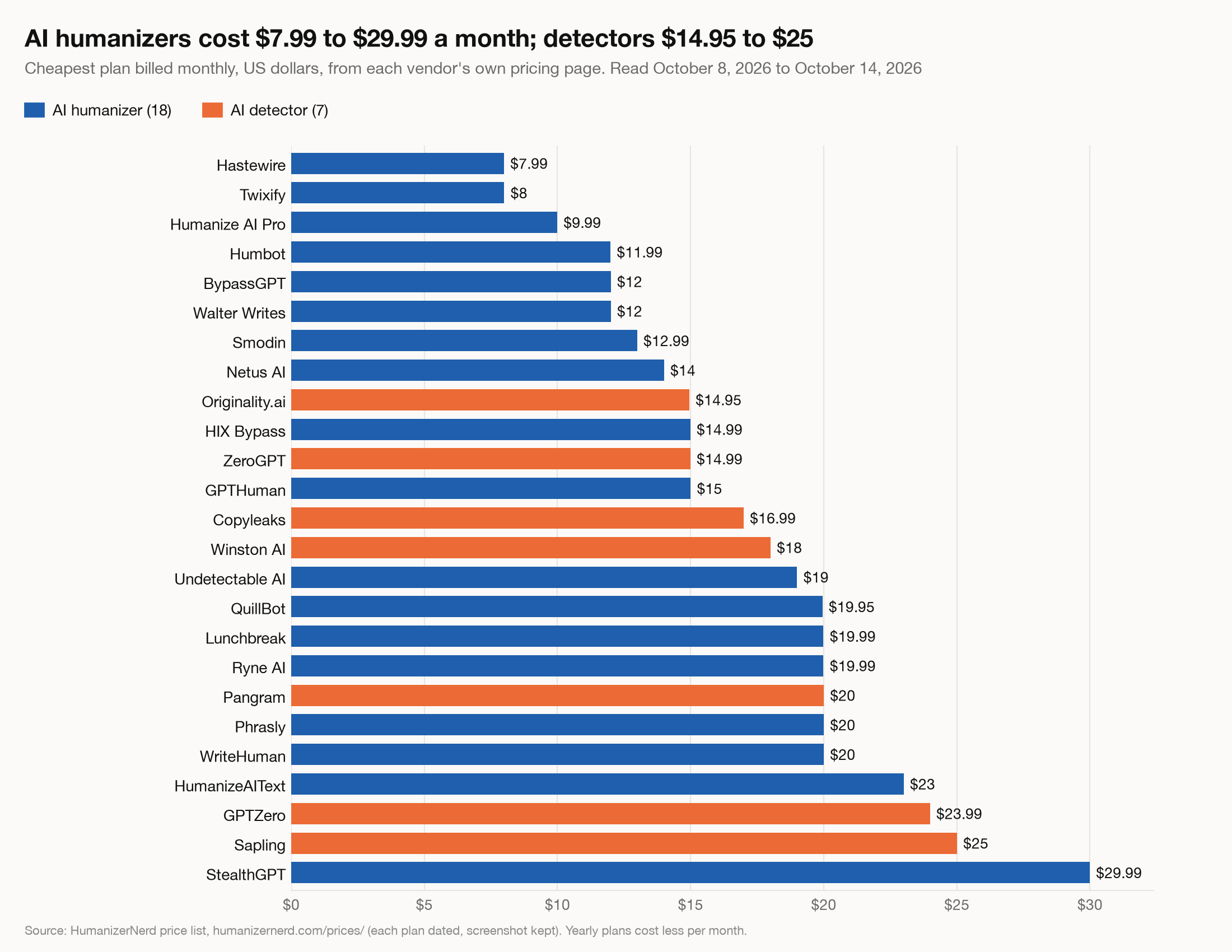
The chart shows the cheapest monthly plan of 25 humanizers and AI detectors from our price files, so you can see where the detectors above sit.
How accurate are AI content detectors?
Accuracy is not one number. In our October test the best tools read most plain AI-generated content as AI and then lost ground on humanized text; ZeroGPT and QuillBot read none of the 23 rewrites as AI. On human writing, the published studies above put Pangram and GPTZero under 3% on long English prose, and short texts are less reliable for every detector. The analysis a tool shows (a score, a label, highlighted sentences) helps you decide what to do next, but none of it identifies who wrote a text. Treat a result as a reason to look closer, then compare it with drafts.
Most AI detection tools are machine learning models trained on examples of human-written content and AI-generated text. Researchers who test AI-generated content detection (the RAID benchmark in our sources is one) vary the model, the topic and the rewriting, and that is why one tool's accuracy on a single test says little about another text. For educators and publishers who care about the authenticity of written content, the useful features are the analysis shown, the user interface for reading it, the research behind it and an honest limit on what it can claim.
Is there an AI detector like Turnitin?
Not one you can check against it. Turnitin sells only to schools and universities, so nobody outside one can run a text through it and compare; nothing on this page is a Turnitin result. What Turnitin says about its own detector and humanized text: does Turnitin detect AI humanizers?
Detectors we haven't tested
- Turnitin: sold only to institutions, so we can't run it. Turnitin's own claim is a false-positive rate under 1% for documents with over 20% AI writing (its AI writing FAQ, updated Oct 14, 2026); scores from 1% to 19% show only as an asterisk.
- Originality.ai and Copyleaks: left out because their terms limit publishing results from their detectors. Prices: Originality.ai from $14.95 a month (read Nov 20, 2026), Copyleaks from $16.99 a month (read Oct 31, 2026).
- Winston AI: not run in October. From $18 a month (read Oct 31, 2026).
- Grammarly's detector: not run in October.
Every detector we track, with every plan: AI detector prices.
How we tested, and the limits
Texts. Five passages written with AI by the HumanizerNerd desk on Oct 9, 2026 (145-167 words), and 23 rewrites of them by 11 free humanizers (Oct 9 and Oct 23), pasted in full, hidden characters included. Detectors. GPTZero and Pangram with free accounts, Sapling and ZeroGPT without, QuillBot with a free account, all at default settings in Chrome on Oct 23, 2026 (QuillBot only in the first round, that morning). One run per text and detector; scores can move between runs. Free limits set how far each got: Pangram's 20 credits covered 10 texts.
Human control. On Oct 31, 2026, 9 human texts written before Nov 30, 2022 (127-194 words: a Wikipedia paragraph, a 2017 journal abstract, a 2021 NASA release, two TOEFL essays and a US 8th-grade essay from the Liang et al. datasets, a Federalist paper paragraph, a 2018 Stack Exchange answer and a 2015 sample cover letter) went once each through GPTZero and Pangram (free accounts) and Sapling and ZeroGPT (no account), default settings, Chrome on a US connection. QuillBot wasn't run: a Cloudflare check blocked it.
What it can't show. Nine human texts read once can't give a false-positive rate; for rates, see the studies named. The originals came from one AI model, and other models' text may score differently. Five short passages is a small, dated test, not a benchmark. No Turnitin result exists or is implied.
Terms. GPTZero's terms of use (last updated Aug 21, 2026) grant access "solely for your personal, non-commercial use"; Pangram's terms of service (last updated Aug 14, 2025) grant it "solely for your internal business use". Neither mentions benchmarks or publishing test results. How we check prices.
Questions
What is the most accurate AI detector?
No single study has tested every detector on the same texts. In independent tests from 2025 and 2026, Pangram and GPTZero are the two tested most often, and both flagged under 3% of human writing. In our own October 2026 test, Pangram read 7 of 9 humanized rewrites as AI and GPTZero 16 of 23, and neither flagged any of 9 human-written texts in a small control.
Is there a free AI detector for teachers?
GPTZero's free account gives 10,000 words a month; Sapling and ZeroGPT run without an account; Pangram's free account came with about 2,000 words. Most universities that provide a detector use Turnitin, so check what your school already licenses before pasting student work into a free tool.
Can AI detectors detect humanized text?
Some of it. In our test, GPTZero still read 16 of 23 humanized rewrites as AI and Pangram 7 of 9, while ZeroGPT and QuillBot read none of them as AI. Independent studies from 2025 and 2026 also found GPTZero missing much of the AI text after a humanizer rewrote it.
Can an AI detector prove a student used AI?
No. Turnitin says its AI indicator should not be the sole basis for action, and GPTZero says the same of its results. A detector score is a reason to talk to the student and look at drafts and version history, not proof.
Which AI detector do universities use?
Mostly Turnitin. Of the 53 universities in our census of 300 that provide an AI detector, 44 use Turnitin's, 4 Copyleaks and 1 Pangram. A third of the 300 run no AI detector at all.
What is an AI content detector and how does it identify AI-generated content?
An AI content detector is a machine learning tool that scores a piece of text by how likely it is to be AI-generated content. The tools we tested show the result as a percentage or a label, and some add sentence highlights. None of these AI detection tools can identify who wrote a text, so a result is a reason to check drafts, not an answer.
Which AI content detection tools suit SEO teams and publishers?
Look for the features covered above: large per-check limits, batch uploads, a plagiarism check and an API for integration with your workflow. Our test used short English passages, so we have not measured long blog articles; run a few of your own written content samples through a free tier before paying.
Do AI detectors work for academic writing and educators?
Educators should treat a score as one input. Turnitin says its AI indicator should not be the sole basis for action, and independent researchers found short texts less reliable for every detector. Academic authenticity is better judged from drafts and version history next to the result.
Sources
- Our test: do AI humanizers work? (Oct 9 and Oct 23, 2026) and every reading (CSV)
- Our human control (Oct 31, 2026), texts from: Wikipedia, "Dust Bowl" (revision of May 25, 2021); Cappuccio & Miller, "Sleep and Cardio-Metabolic Disease", Current Cardiology Reports, 2017; NASA release 21-005, Jan 14, 2021; Liang et al. TOEFL and Hewlett ASAP essay data (GitHub, Weixin-Liang/ChatGPT-Detector-Bias); The Federalist No. 10 (1787, Avalon Project); The Great Outdoors Stack Exchange answer 18393 (Feb 2, 2018); Lawrence University Career Services, sample cover letter (May 6, 2015)
- Epoch AI, "AI detectors' false negatives" data insight, Jul 15, 2026: epoch.ai
- Isley, Gaebler & Goel, arXiv 2609.22549, Sep 18, 2026
- Karr, Khvatskii, Hua & Chawla, "Why AI Detection Fails for Academic Integrity", arXiv 2608.11256, Aug 2026
- Van Vlasselaer, Van Droogenbroeck & Spruyt, International Journal for Educational Integrity 22:16, Jun 29, 2026
- Paredes, Druck, Benson & Smith (Graphite), "AI now writes as many online articles as humans do", May 15, 2026: graphite.io
- Jabarian & Imas, "Artificial Writing and Automated Detection", NBER Working Paper 34223, Sep 2025
- Pratama, PeerJ Computer Science 11:e2953, Jun 23, 2025
- Dugan et al., "RAID: A Shared Benchmark for Robust Evaluation of Machine-Generated Text Detectors", ACL 2024, arXiv 2405.07940
- Weber-Wulff et al., "Testing of detection tools for AI-generated text", International Journal for Educational Integrity 19:26, Dec 25, 2023
- Liang, Yuksekgonul, Mao, Wu & Zou, "GPT detectors are biased against non-native English writers", Patterns 4(7), Jul 2023
- Vendor pages, read Oct 22, 2026: GPTZero homepage and technology page; Pangram 4 model card (Jul 29, 2026); Sapling, ZeroGPT and QuillBot detector pages; Turnitin AI writing FAQ
- Terms read Oct 31, 2026: gptzero.me/terms-of-use.html (last updated Aug 21, 2026); pangram.com/terms-of-service (last updated Aug 14, 2025)
- Prices: each vendor's own pricing page, read from a US connection on the date shown beside it